
As the number of EVs increases, so does the need for EV charging infrastructure. However, setting up such infrastructure can come with various challenges, which unfortunately is especially true for residential areas where there is an additional set of questions; who can charge on certain charging points and when, as well as the process of obtaining the appropriate permits and documentation to install the charging station.
Accessible charging infrastructure is the main enabler of the green transition
Across Europe, residential charging remains one of the most important parts of the charging mix. According to the European Commission, cars are parked on average 23 hours per day, and by 2030, 60% to 85% of all recharging is expected to take place at private recharging points. This makes residential buildings, including multi-family homes, a key part of the charging infrastructure discussion.
The good news is that EU legislation is moving in this direction. Under the revised EU Energy Performance of Buildings Directive, all parking spaces in new multi-family buildings, and in multi-family buildings undergoing major renovation, must be technically prepared for the future installation of charging points. New multi-family building car parks must also include at least one charging point. For office buildings, the requirements are becoming stronger as well: since 30 May 2026, new office buildings and office buildings undergoing major renovation are required to provide one charging point for every two parking spaces.
The challenges of multi-family housing can be segmented into the categories below but vary from market to market (Delta Energy & Environment, 2020):
- Technical challenges: physical installation and operation of the EV charging infrastructure (e.g. the amount of power available for charging, the length of wiring, etc.).
- Structural challenges: challenges related to the property’s organisation, and set-up (e.g. EV driver getting permission to install a charging station).
- Policy challenges: regulation, legislation, and policy which can be either the driver or the barrier (e.g. governmental initiatives or regulation regarding the instalment of charging stations).
- Market challenges: market specific challenges related to the EV or multi-family markets (e.g. low penetration of EVs had created insufficient demand for charging stations in multi-family homes).
Our CEO, Lovrenc Švegl, recently made a similar point in an interview with Slovenske novice, describing charging in front of apartment buildings as a multi-layered challenge. In many existing residential developments, the charging station itself is only one part of the equation. Before chargers can be installed and used properly, questions around parking ownership, cabling, construction work, available connection power, backend management, and payment handling also need to be solved. His view underlines why residential charging in multi-family homes should be planned as a shared infrastructure project, not only as the installation of individual chargers.
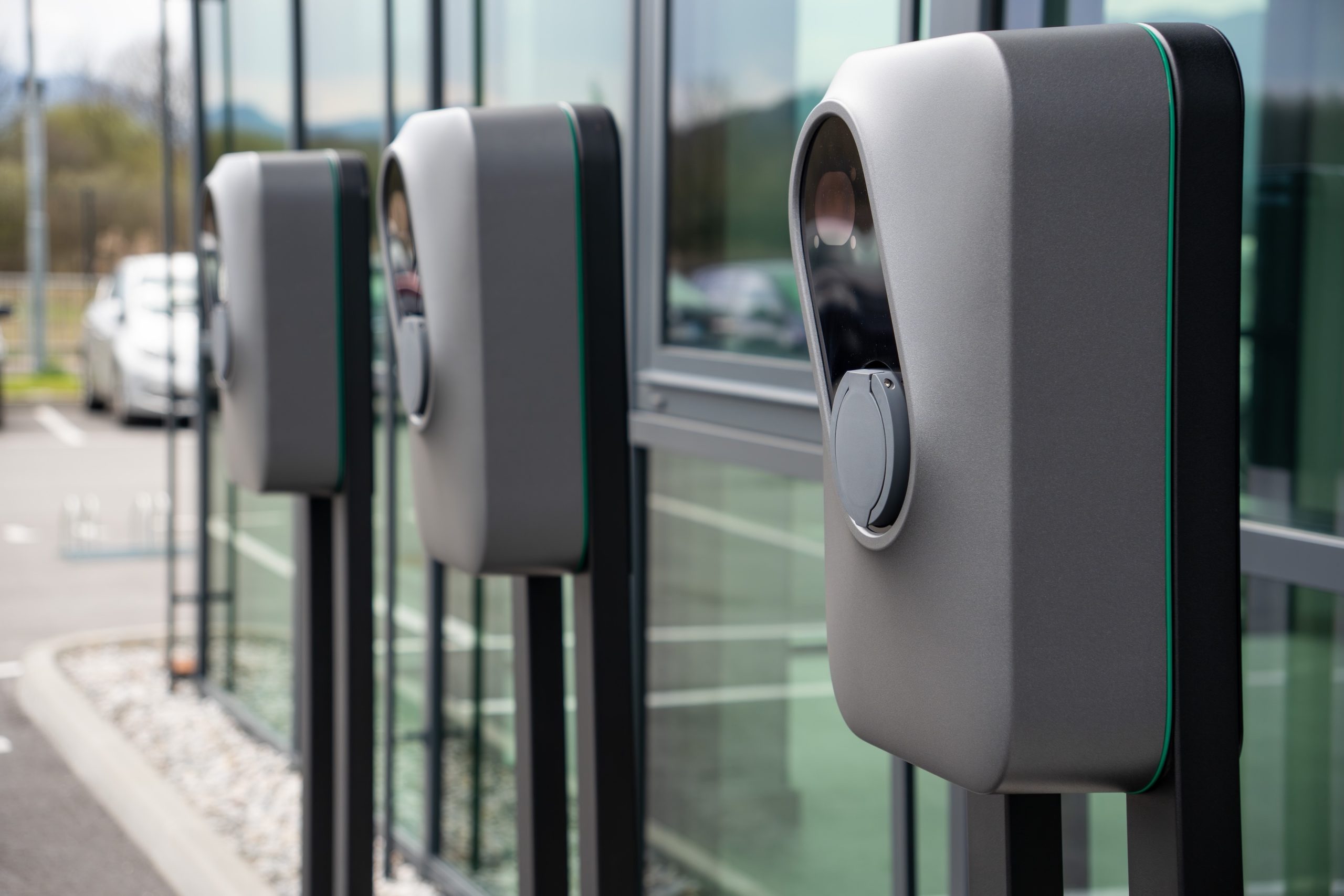
If the parking spaces are already pre-wired and protected by the property rights, no major issues should be expected when installing an EV charger, since the developer is usually the manager of the building, authorized by the unit owners, and each owner of the parking space is responsible for acquiring a charging station themselves. Note: in some cases, the installation of a charging station may require the consent of the residents of the building.
However, if parking spaces are shared, not clearly assigned, or owned by several parties, the matter may not be so simple. In such cases, the key questions are who can approve the installation, who pays for the shared infrastructure, and who manages the charging system once it is in use. This is why it is important to involve the building manager or another responsible party early in the process and plan the installation in a way that can be scaled later.
Choosing charging stations with dynamic load management also helps optimise the available power and allows more vehicles to charge simultaneously without overloading the electrical installation.
Parking spaces with multiple owners
A single parking space does not have only one owner and can be used by any resident of the block. In this case, legislation is usually the most deficient. Indeed, it could happen that a single resident prevents the installation of the charging infrastructure, as the legislation often requires 100% consent of the residents. In this case, a joint solution with the rest of the residents must be found. It is therefore recommended that in such a case, the charging station provider contacts the community manager to discuss how to prepare the installation so that it can be scaled in the future. The building manager will also be responsible for measuring energy consumption; however, the charging station needs to enable user management/identification in order to do so.
In many residential areas, people rely on shared outdoor parking, municipal parking, or street parking, which makes home charging harder to organise. In these cases, public or semi-public charging becomes especially important and it is a good idea to involve charging service providers who obtain the consent of property owners – usually municipalities or residents, to set up this infrastructure, similar to the way public charging infrastructure is set up.
However, charging services in this case can only be provided by companies that offer public charging services. In cases where drivers need to park on the side of the road due to the lack of parking spaces, the potential charging infrastructure requires a lot of attention and proper planning, as well as the right technical solutions, which is why it is right for the municipality to commit to it. In some cases, one of the solutions for local companies that have their own charging stations in the area to make them available to the public overnight thus increasing the efficiency of their infrastructure.
Final thoughts
In summary, equipping residential areas with EV charging stations remains a challenge due to the long process for installation, lack of electricity supply, lack of parking options in residential areas, multiple ownership of parking lots, etc. The good news is that legislation in the EU now requires all new buildings, commercial centres, and workplaces to provide the infrastructure to install charging stations. Many European governments, as well as the UK, are offering incentives in the form of grants, tax deductions or rebates to encourage the mass adoption of electric vehicle charging stations.
Planning EV charging for a residential project? Get in touch with our team to discuss the right approach for your site.